Customer Lookup Pos Warning: an Error Occurred

Points of auction at a Target retail shop
The point of sale (POS) or bespeak of purchase (POP) is the time and identify where a retail transaction is completed. At the point of auction, the merchant calculates the amount owed by the customer, indicates that amount, may prepare an invoice for the customer (which may be a cash register printout), and indicates the options for the customer to make payment. It is also the point at which a customer makes a payment to the merchant in substitution for goods or after provision of a service. After receiving payment, the merchant may effect a receipt for the transaction, which is usually printed only can besides be dispensed with or sent electronically.[ane] [2] [3]
To calculate the amount owed past a customer, the merchant may utilise various devices such as weighing scales, barcode scanners, and cash registers (or the more advanced "POS cash registers", which are sometimes also chosen "POS systems"[iv] [5]). To make a payment, payment terminals, touch screens, and other hardware and software options are available.
The point of auction is often referred to as the bespeak of service considering it is not but a point of sale but also a signal of return or customer order. POS terminal software may also include features for additional functionality, such as inventory management, CRM, financials, or warehousing.
Businesses are increasingly adopting POS systems, and one of the about obvious and compelling reasons is that a POS organization does abroad with the need for cost tags. Selling prices are linked to the product code of an item when adding stock, and so the cashier merely needs to scan this code to process a sale. If at that place is a price change, this can also be hands done through the inventory window. Other advantages include the power to implement diverse types of discounts, a loyalty scheme for customers, and more efficient stock control, and these features are typical of almost all modernistic ePOS systems.
Terminology [edit]
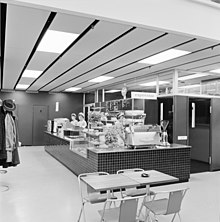
Retailers and marketers will ofttimes refer to the area effectually the checkout instead equally the point of purchase (Pop) when they are discussing information technology from the retailer'south perspective. This is especially the case when planning and designing the area as well equally when considering a marketing strategy and offers.
Some bespeak of sale vendors refer to their POS system as "retail management system" which is actually a more advisable term given that this software is no longer but about processing sales but comes with many other capabilities such as inventory management, membership system, supplier record, bookkeeping, issuing of purchase orders, quotations and stock transfers, hide barcode characterization creation, sale reporting and in some cases remote outlets networking or linkage, to proper name some major ones.
Nevertheless, it is the term POS system rather than retail direction system that is in vogue amidst both terminate-users and vendors.
The bones, fundamental definition of a POS Organisation, is a organisation which allows the processing and recording of transactions between a company and their consumers, at the time in which goods and/or services are purchased.
History [edit]
Software before the 1990s [edit]

Early electronic cash registers (ECR) were controlled with proprietary software and were express in function and advice adequacy. In August 1973, IBM released the IBM 3650 and 3660 shop systems that were, in essence, a mainframe computer used as a store controller that could control up to 128 IBM 3653/3663 point of auction registers. This arrangement was the first commercial utilize of client-server technology, peer-to-peer communications, local area network (LAN) simultaneous backup, and remote initialization. By mid-1974, it was installed in Pathmark stores in New Jersey and Dillard's department stores.
One of the outset microprocessor-controlled greenbacks register systems was congenital by William Brobeck and Associates in 1974, for McDonald's Restaurants.[half-dozen] It used the Intel 8008, a very early on microprocessor (and forerunner to the Intel 8088 processor used in the original IBM Personal Estimator). Each station in the eatery had its ain device which displayed the entire gild for a customer — for example, [2] Vanilla Shake, [one] Large Fries, [iii] BigMac — using numeric keys and a push button for every bill of fare detail. By pressing the [Grill] push button, a 2nd or third society could exist worked on while the offset transaction was in progress. When the customer was fix to pay, the [Total] button would calculate the beak, including sales tax for almost whatever jurisdiction in the United States. This made it authentic for McDonald'south and very convenient for the servers and provided the restaurant possessor with a check on the amount that should exist in the cash drawers. Upwards to eight devices were continued to i of two interconnected computers so that printed reports, prices, and taxes could be handled from whatever desired device by putting information technology into Managing director Mode. In improver to the mistake-correcting retention, accuracy was enhanced by having three copies of all of import information with many numbers stored only equally multiples of three. Should i computer fail, the other could handle the entire shop.

In 1986, Eugene "Gene" Mosher introduced the first graphical point of sale software[7] featuring a touchscreen interface under the ViewTouch[8] trademark on the xvi-fleck Atari 520ST color estimator.[9] It featured a color touchscreen widget-driven interface that allowed configuration of widgets representing menu items without depression level programming.[10] The ViewTouch point of sale software was first demonstrated in public at Fall Comdex, 1986,[eleven] in Las Vegas Nevada to large crowds visiting the Atari Computer booth. This was the first commercially available POS system with a widget-driven color graphic touch on screen interface and was installed in several restaurants in the United states and Canada.
In 1986, IBM introduced its 468x series of POS equipment based on Digital Research's Concurrent DOS 286 and FlexOS one.20, a modular real-time multi-tasking multi-user operating system.
Mod software (mail service-1990s) [edit]
A wide range of POS applications have been adult on platforms such as Windows and Unix. The availability of local processing power, local data storage, networking, and graphical user interface made it possible to develop flexible and highly functional POS systems. Price of such systems has likewise declined, as all the components can now be purchased off-the-shelf.
In 1993, IBM adopted FlexOS 2.32 as the footing of their IBM 4690 Os in their 469x series of POS terminals. This was adult up to 2014 when it was sold to Toshiba, who connected to support it up to at to the lowest degree 2017.
As far equally computers are concerned, off-the-shelf versions are ordinarily newer and hence more powerful than proprietary POS terminals. Custom modifications are added every bit needed. Other products, like touchscreen tablets and laptops, are readily available in the market, and they are more portable than traditional POS terminals. The just advantage of the latter is that they are typically built to withstand crude handling and spillages; a benefit for food & beverage businesses.
The key requirements that must exist met past modern POS systems include high and consistent operating speed, reliability, ease of apply, remote supportability, low cost, and rich functionality. Retailers tin can reasonably expect to acquire such systems (including hardware) for near $4000 US (every bit of 2009) per checkout lane.
Reliability depends not wholly on the developer but at times on the compatibility between a database and an Os version. For example, the widely used Microsoft Admission database arrangement had a compatibility issue when Windows XP machines were updated to a newer version of Windows. Microsoft offered no immediate solution. Some businesses were severely disrupted in the process, and many downgraded dorsum to Windows XP for a quick resolution. Other companies utilized customs support, for a registry tweak solution has been found for this.[12] [ unreliable source ]
POS systems are one of the most complex software systems available considering of the features that are required past different terminate-users. Many POS systems are software suites that include sale, inventory, stock counting, vendor ordering, customer loyalty and reporting modules. Sometimes purchase ordering, stock transferring, quotation issuing, barcode creating, bookkeeping or even accounting capabilities are included. Furthermore, each of these modules is interlinked if they are to serve their applied purpose and maximize their usability.
For instance, the sale window is immediately updated on a new member entry through the membership window because of this interlinking. Similarly, when a sale transaction is fabricated, whatsoever buy past a member is on record for the membership window to report providing information like payment type, appurtenances purchased, engagement of buy and points accumulated. Comprehensive assay performed by a POS car may need to process several qualities about a single product, like selling cost, rest, average cost, quantity sold, description and department. Highly complex programming is involved (and possibly considerable figurer resources) to generate such all-encompassing analyses.
POS systems are designed not but to serve the retail, wholesale and hospitality industries equally historically is the case. Present POS systems are also used in goods and holding leasing businesses, equipment repair shops, healthcare management, ticketing offices such as cinemas and sports facilities and many other operations where capabilities such as the following are required: processing budgetary transactions, allocation and scheduling of facilities, keeping record and scheduling services rendered to customers, tracking of goods and processes (repair or manufacture), invoicing and tracking of debts and outstanding payments.
Different customers have different expectations within each trade. The reporting functionality alone is subject field to and so many demands, especially from those in the retail/wholesale industry. To cite special requirements, some concern's goods may include perishables and hence the inventory arrangement must be capable of prompting the admin and cashier on expiring or expired products. Some retail businesses require the system to store credit for their customers, credit which can exist used subsequently to pay for goods. A few companies even expect the POS system to comport like a full-fledged inventory management organisation, including the ability to provide even FIFO (Showtime In Outset Out) and LIFO (Last In Kickoff Out), reports of their appurtenances for bookkeeping and tax purposes.
In the hospitality industry, POS system capabilities tin can also diverge significantly. For instance, while a restaurant is typically concerned nearly how the sale window functions, whether it has functionality such every bit for creating item buttons, for various discounts, for calculation a service charge, for holding of receipts, for queuing, for table service as well as for takeaways, merging and splitting of a receipt, these capabilities may yet be bereft for a spa or slimming centre which would require in addition a scheduling window with historical records of customers' attendance and their special requirements.
A POS system can be fabricated to serve different purposes to different end-users depending on their business concern processes. Quite ofttimes an off-the-shelf POS organization is inadequate for customers; some customization is required, and this is why a POS system can become very complex. The complication of a mature POS arrangement even extends to remote networking or interlinking between remote outlets and the HQ such that updating both ways is possible. Some POS systems offer the linking of spider web-based orders to their sale window. Even when local networking is only required (equally in the case of a high-traffic supermarket), at that place is the ever-present challenge for the developer to keep most if not all of their POS stations running. This puts high demand not just on software coding but too designing the whole system covering how private stations and the network work together, and special consideration for the performance capability and usage of databases. Due to such complication, bugs and errors encountered in POS systems are frequent.[13]
With regards to databases, POS systems are very demanding on their performance considering of numerous submissions and retrievals of data - required for correct sequencing the receipt number, checking up on various discounts, membership, calculating subtotal, so forth - just to process a unmarried sale transaction. The immediacy required of the organization on the sale window such as may be observed at a checkout counter in a supermarket also cannot exist compromised. This places much stress on individual enterprise databases if at that place are just several tens of thousands of sale records in the database. Enterprise database Microsoft SQL Server, for example, has been known to freeze up (including the OS) entirely for many minutes under such weather showing a "Timeout Expired" error bulletin. Fifty-fifty a lighter database like Microsoft Access will slow to a crawl over time if the trouble of database bloating is non foreseen and managed by the arrangement automatically. Therefore, the need to practise extensive testing, debugging and improvisation of solutions to preempt failure of a database before commercialization farther complicates the evolution.
POS organization accuracy is demanding, given that monetary transactions are involved continuously non only via the sale window simply also at the back-stop through the receiving and inputting of goods into the inventory. Calculations required are non e'er straightforward. At that place may be many discounts and deals that are unique to specific products, and the POS machine must quickly process the differences and the effect on pricing. There is much complexity in the programming of such operations, especially when no error in adding can be allowed.
Other requirements include that the system must have functionality for membership discount and points accumulation/usage, quantity and promotional discounts, mix and match offers, cash rounding up, invoice/delivery-club issuance with outstanding amount. It should enable a user to accommodate the inventory of each production based on physical count, track expiry of perishable goods, change pricing, provide audit trail when modification of inventory records is performed, exist capable of multiple outlet functionality, command of stocks from HQ, doubling equally an invoicing system, just to name some.
It is clear that POS organization is a term that implies a broad range of capabilities depending on the finish-user requirements. POS system review websites cannot exist expected to cover most allow alone all the features; in fact, unless one is a developer himself, it is unrealistic to expect the reviewer to know all the nuts and bolts of a POS system. For instance, a POS system might work smoothly on a test database during the review just not when the database grows significantly in size over months of usage. And this is only one among many hidden critical functionality issues of a POS system.
Hardware interface standardization (post-1980s) [edit]
Vendors and retailers are working to standardize development of computerized POS systems and simplify interconnecting POS devices. Two such initiatives were OPOS and JavaPOS, both of which arrange to the UnifiedPOS standard led by The National Retail Foundation.
OPOS (OLE for POS) was the first commonly adopted standard and was created by Microsoft, NCR Corporation, Epson and Fujitsu-ICL. OPOS is a COM-based interface compatible with all COM-enabled programming languages for Microsoft Windows. OPOS was outset released in 1996. JavaPOS was adult by Dominicus Microsystems, IBM, and NCR Corporation in 1997 and outset released in 1999. JavaPOS is for Java what OPOS is for Windows, and thus largely platform contained.
In that location are several advice means POS systems utilize to control peripherals such as:
- Logic Controls \ BemaTech
- Epson Esc/POS
- UTC Standard
- UTC Enhanced
- AEDEX
- ICD 2002
- Ultimate
- CD 5220
- DSP-800
- ADM 787/788
- HP
In that location are likewise about as many proprietary protocols as there are companies making POS peripherals. Most POS peripherals, such as displays and printers, support several of these control protocols in order to piece of work with many unlike brands of POS terminals and computers.
User interface blueprint [edit]
The pattern of the sale window is the most important ane for the user. This user interface is highly critical when compared to those in other software packages such equally word editors or spreadsheet programs where the speed of navigation is not so crucial for business organization operation.
For businesses at prime number locations where real estate comes at a premium, it can be common to see a queue of customers. The faster a sale is completed the shorter the queue time which improves customer satisfaction, and the less space information technology takes, which benefits shoppers and staff. High-traffic operations such as grocery outlets and cafes need to process sales speedily at the sales counter then the UI flow is often designed with every bit few popups or other interruptions to ensure the operator isn't distracted and the transaction can be processed as quickly as possible.
Although improving the ergonomics is possible, a clean, fast-paced look may come at the expense of sacrificing functions that are oftentimes wanted by terminate-users such every bit discounts, access to commission earned screens, membership and loyalty schemes can involve looking at a different function of the POS to ensure the bespeak of sale screen contains only what a cashier needs at their disposal to serve customers.
Cloud-based (post-2000s) [edit]
The appearance of deject computing has given nativity to the possibility of electronic point of sale (EPOS) systems[xiv] to exist deployed as software as a service, which can be accessed directly from the Internet using any internet browser. Using the previous advances in the communication protocols for POS's command of hardware, cloud-based POS systems are independent from platform and operating system limitations. EPOS systems based in the cloud (well-nigh small-concern POS today) are generally subscription-based, which includes ongoing customer back up.[fifteen]
Compared to regular cash registers (which tend to be significantly cheaper but only process sales and prints receipts), POS systems include automatic updating of the inventory library stock levels when you sell products, real-time reports accessible from a remote estimator, staff timesheets and a customer library with loyalty features.[16] [ clarification needed ] [ clarification needed ]
Cloud-based POS systems are also created to be compatible with a broad range of POS hardware and sometimes tablets such as Apple tree's iPad. Thus cloud-based POS also helped expand POS systems to mobile devices, such every bit tablet computers or smartphones.[17]
These devices can as well deed as barcode readers using a built-in photographic camera and as payment terminals using built-in NFC engineering or an external payment carte du jour reader. A number of POS companies congenital their software specifically to be cloud-based. Other businesses who launched pre-2000s have since adjusted their software to evolving technology.
Cloud-based POS systems are different from traditional POS largely because user data, including sales and inventory, are non stored locally, but in a remote server. The POS system is too not run locally, then there is no installation required.
Depending on the POS vendor and the terms of contract, compared to traditional on-premises POS installation, the software is more than likely to be continually updated by the programmer with more than useful features and improve performance in terms of computer resources at the remote server and in terms of lesser bugs and errors.
Other advantages of a deject-based POS are instant centralization of data (of import especially to concatenation stores), ability to admission data from anywhere there is internet connection, and lower start-upward costs.[xviii] [19]
Cloud based POS requires an net connection. For this reason it important to use a device with 3G connectivity in case the device'south primary cyberspace goes down. In addition to being significantly less expensive than traditional legacy point of sale systems, the existent strength of a deject based bespeak of sale system is that there are developers all over the world creating software applications for cloud based POS. Cloud based POS systems are often described[ by whom? ] as future proof as new applications are constantly being conceived and congenital.
A number of noted emerging cloud-based POS systems came on the scene less than a decade or even half a decade back. These systems are commonly designed for restaurants, pocket-sized and medium-sized retail operations with adequately simple sale processes as can be culled from POS system review sites. It appears from such software reviews that enterprise-level deject-based POS systems are currently lacking in the market. "Enterprise-level" here ways that the inventory should be capable of treatment a large number of records, such as required past grocery stores and supermarkets. It can also hateful that the organisation—software and cloud server—must be capable of generating reports such as analytics of sale confronting inventory for both a single and multiple outlets that are interlinked for administration by the headquarters of the business functioning.
POS vendors of such cloud based systems should also have a strong contingency programme for the breakdown of their remote server such as represented by fail-over server support. Even so, sometimes even a major data center can fail completely, such as in a fire.[xx] On-bounds installations are therefore sometimes seen alongside cloud-based implementation to preempt such incidents, specially for businesses with very high traffic. However the on-premises installations may not have the most up-to-engagement inventory and membership data.
For such contingency, a more innovative though highly complex approach for the programmer is to have a trimmed down version of the POS system installed on the cashier computer at the outlet. On a daily footing the latest inventory and membership information from the remote server is automatically updated into the local database. Thus should the remote server neglect, the cashier can switch over to the local sale window without disrupting sales. When the remote server is restored and the cashier switches over to the cloud organization, the locally processed sale records are then automatically submitted to the remote system, thus maintaining the integrity of the remote database.
Although cloud-based POS systems save the finish-user startup toll and technical challenges in maintaining an otherwise on-premises installation, at that place is a risk that should the cloud-based vendor close down information technology may event in more immediate termination of services for the finish-user compared to the case of a traditional full on-bounds POS system where information technology can still run without the vendor.
Another consideration is that a deject-based POS system actually exposes business data to service providers - the hosting service visitor and the POS vendor which have access to both the application and database. The importance of securing critical business information such as supplier names, acme selling items, customer relationship processes cannot be underestimated given that sometimes the few key success factors or merchandise secrets of a business are really accessible through the POS organisation. This security and privacy business is an ongoing result in cloud computing.
Retail industry [edit]

The retail industry is one of the predominant users of POS terminals. A retail point of sale system typically includes a greenbacks annals (which in recent times comprises a computer, monitor, cash drawer, receipt printer, customer display and a barcode scanner) and the majority of retail POS systems[21] also include a debit/credit carte du jour reader. It tin too include a conveyor belt, checkout divider, weight scale, integrated credit card processing system, a signature capture device and a client pivot pad device. While the organization may include a keyboard and mouse, more and more than POS monitors use touch-screen engineering for ease of use, and a reckoner is built into the monitor chassis for what is referred to as an all-in-1 unit of measurement. All-in-ane POS units liberate counter space for the retailer. The POS organization software can typically handle a myriad of customer based functions such equally sales, returns, exchanges, layaways, souvenir cards, gift registries, client loyalty programs, promotions, discounts and much more. POS software tin can also permit for functions such every bit pre-planned promotional sales, manufacturer coupon validation, strange currency handling and multiple payment types.
The POS unit handles the sales to the consumer but it is only 1 part of the entire POS system used in a retail business. "Back-office" computers typically handle other functions of the POS system such as inventory control, purchasing, receiving and transferring of products to and from other locations. Other typical functions of a POS arrangement are: store sales information for enabling customer returns, reporting purposes, sales trends and cost/toll/profit assay. Client information may be stored for receivables management, marketing purposes and specific buying analysis. Many retail POS systems include an accounting interface that "feeds" sales and cost of goods data to contained accounting applications.
A multiple point of sale system used past big retailers similar supermarkets and section stores has a far more than demanding database and software architecture than that of a unmarried station seen in small retail outlets. A supermarket with high traffic cannot afford a systemic failure, hence each signal of sale station should not merely be very robust both in terms of software, database and hardware specifications only also designed in such a way as to prevent causing a systemic failure - such as may happen through the use of a unmarried central database for operations.
At the same time updating between multiple stations and the back end authoritative computer should exist capable of being efficiently performed, so that on ane hand either at the showtime of the day or at whatever time each station will have the latest inventory to process all items for sale, while on the other paw at the end of the day the back stop administrative estimator can be updated in terms of all sale records.
This gets even more complicated when there is a membership arrangement requiring real-fourth dimension two-way updating of membership points between sale stations and the back end administrative computer.
Retail operations such as hardware stores (lumber yards), electronic stores and so-called multifaceted superstores need specialized additional features compared to other stores. POS software in these cases handles special orders, buy orders, repair orders, service and rental programs as well as typical signal of sale functions. Rugged hardware is required for point of auction systems used in outdoor environments. Wireless devices, battery powered devices, all-in-one units, and Internet-set machines are typical in this manufacture.
Recently new applications take been introduced, enabling POS transactions to be conducted using mobile phones and tablets. Co-ordinate to a contempo study, mobile POS (mPOS) terminals are expected to replace the contemporary payment techniques because of various features including mobility, upfront low cost investment and better user feel.[22]
In the mid-2000s, the blind community in the Usa engaged in structured negotiations to ensure that retail point of sale devices had tactile keypads. Without keys that can be felt, a blind person cannot independently enter her or his PIN. In the mid-2000s retailers began using "flat screen" or "signature capture" devices that eliminated tactile keypads. Bullheaded people were forced to share their confidential Pivot with store clerks in society to employ their debit and other Pin-based cards. The blind community reached agreement with Walmart, Target, CVS and 8 other retailers that required existent keys so bullheaded people could employ the devices.
Physical configuration [edit]
Early stores typically kept trade behind a counter. Staff would fetch items for customers to prevent the opportunity for theft and sales would exist fabricated at the aforementioned counter. Cocky-service grocery stores such as Piggly Wiggly, beginning in 1916, allowed customers to fetch their own items and pass the point of sale on the mode to the exit.
Many stores have a number of checkout stations. Some stations may have an automated cashier (self-checkout). Express lanes might limit the blazon of payment, or number or blazon of goods, to expedite service. If each checkout station has a separate queue, customers have to gauge which line volition move the fastest, to minimize their wait times; they are often frustrated to be wrong or be stuck backside another customer who encounters a problem or who takes a long fourth dimension to check out. Some stores utilize a unmarried, much longer simply faster-moving line, that is served past multiple registers, which produces the same average wait time, but reduces the frustration and variance in wait time from person to person.[23] Regardless of the configuration, checkout lines usually pass by impulse buy items to grab the attending of otherwise idle customers.
Hospitality industry [edit]


Hospitality point of sale systems are computerized systems incorporating registers, computers and peripheral equipment, usually on a computer network to be used in restaurants, hair salons or hotels. Similar other point of sale systems, these systems continue track of sales, labor and payroll, and tin can generate records used in bookkeeping and bookkeeping. They may be accessed remotely by eatery corporate offices, troubleshooters and other authorized parties.
Betoken of auction systems have revolutionized the restaurant industry, particularly in the fast food sector. In the virtually recent technologies, registers are computers, sometimes with touch screens. The registers connect to a server, ofttimes referred to as a "shop controller" or a "key control unit". Printers and monitors are likewise found on the network. Additionally, remote servers tin can connect to store networks and monitor sales and other shop information.
Typical eatery POS software is able to create and print guest checks, print orders to kitchens and bars for preparation, process credit cards and other payment cards, and run reports. In addition, some systems implement wireless pagers and electronic signature-capture devices.
In the fast nutrient manufacture, displays may be at the front counter, or configured for drive-through or walk-through cashiering and order taking. Front counter registers let taking and serving orders at the aforementioned last, while drive-through registers allow orders to exist taken at one or more drive-through windows, to be cashiered and served at another. In addition to registers, bulldoze-through and kitchen displays are used to view orders. In one case orders announced they may be deleted or recalled by the touch interface or by bump confined. Drive-through systems are ofttimes enhanced past the use of drive-through wireless (or headset) intercoms. The efficiency of such systems has decreased service times and increased efficiency of orders.
Another innovation in technology for the eatery manufacture is wireless POS. Many restaurants with loftier volume employ wireless handheld POS to collect orders which are sent to a server. The server sends required data to the kitchen in existent time. Wireless systems consist of bulldoze-through microphones and speakers (oftentimes one speaker volition serve both purposes), which are wired to a "base of operations station" or "center module." This, in turn, will broadcast to headsets. Headsets may exist an all-in-one headset or one connected to a belt pack.
In hotels, POS software allows for transfer of meal charges from dining room to invitee room with a button or two. Information technology may also demand to exist integrated with holding management software.
Newer, more sophisticated systems are getting away from the primal database "file server" blazon system and going to what is called a "cluster database". This eliminates whatsoever crashing or arrangement downtime that tin be associated with the back part file server. This technology allows 100% of the information to non only be stored, but also pulled from the local terminal, thus eliminating the need to rely on a dissever server for the organisation to operate.
Tablet POS systems popular for retail solutions are now available for the restaurant industry. Initially these systems were not sophisticated and many of the early systems did not support a remote printer in the kitchen. Tablet systems today are being used in all types of restaurants including table service operations. Most tablet systems upload all data to the Net and so managers and owners tin can view reports from anywhere with a password and Internet connectedness. Smartphone Internet access has made alerts and reports from the POS very accessible. Tablets take helped create the Mobile POS organization, and Mobile POS applications likewise include payments, loyalty, online ordering, tabular array side ordering by staff and table superlative ordering by customers. Regarding the payments, mobile POS tin accept all kinds of payment methods from contactless cards, EMV fleck-enabled cards, and mobile NFC enabled cards.[24] Mobile POS (AKA mPOS) is growing quickly with new developers entering the market place almost on a daily footing.
With the proliferation of depression-priced touchscreen tablet computers, more and more restaurants take implemented self-ordering through tablet POS placed permanently on every tabular array. Customers tin browse through the carte on the tablet and place their orders which are then sent to the kitchen. Almost restaurants that take iPad cocky-order menus include photos of the dishes so guests can easily choose what they want to order. This plain improves service and saves manpower on the office of the restaurant. Even so this depends on how intelligently the organisation has been programmed to exist.
As a case in point, some cocky-ordering systems non requiring staff help may not properly recognize a subsequent social club from the same client at a table. Every bit a result, the customer is left waiting and wondering why his second order of food and drink is not being served.
Another example of how intelligent the system can be, is whether an order that has been placed but not yet been processed by the kitchen tin can be modified by the client through the tablet POS. For such an unprocessed order the customer should be given the option to easily retrieve his society and modify information technology on the tablet POS. Merely when his order is existence processed this function should then be automatically disabled.
Self-ordering systems are not always free completely from intervention by the staff and for some skilful reasons. For example, some restaurants require that items selected past the customers be attended to and can only be placed past the waiter who has the password required to do so. This prevents imitation orders - such as may be entered by playful kids - and subsequent dispute on the items ordered. If alcoholic drinks are ordered, it besides becomes necessary for the waiter to first verify the age of the customer earlier sending the lodge.
The technical specifications for implementing such self-ordering system are more demanding than a unmarried cashier-controlled POS station. On the software and hardware side each tablet on a customer table has to be networked to the cashier POS station and the kitchen computer and so that both are continually updated on orders placed. The common database that serves this network must too be capable of serving many concurrent users - cashier, customers, kitchen and possibly even a drink bar.
Information technology is therefore to exist noted past developers that some databases like popularly used Microsoft Access may have the specifications that it is capable of usage past multiple concurrent users. However under the stress of a POS system, they can neglect miserably resulting in constant errors and corruption of data.
POS systems are often designed for a variety of clients, and can exist programmed by the cease users to suit their needs. Some big clients write their own specifications for vendors to implement. In some cases, POS systems are sold and supported by third-political party distributors, while in other cases they are sold and supported straight past the vendor.
The selection of a eating house POS organization is critical to the restaurant'due south daily operation and is a major investment that the restaurant's management and staff must live with for many years. The eating house POS system interfaces with all phases of the eating place functioning and with anybody that is involved with the restaurant including guests, suppliers, employees, managers and owners. The selection of a restaurant POS system is a complex process that should be undertaken by the restaurant owner and not delegated to an employee. The purchase procedure can be summarized into three steps: Design, Compare and Negotiate. The Design footstep requires enquiry to decide which eating place POS features are needed for the restaurant functioning. With this data the eatery owner or manager can Compare various eating house POS solutions to make up one's mind which POS systems meet their requirements. The final step is to Negotiate the price, payment terms, included training, initial warranty and ongoing support costs.[ citation needed ]
Accounting forensics [edit]
POS systems record sales for business and taxation purposes. Illegal software dubbed "zappers" can be used on POS devices to falsify these records with a view to evading the payment of taxes.
In some countries, legislation is being introduced to make greenbacks register systems more than secure. For example, the French treasury is estimated to be declining to collect approximately €14 billion of VAT revenue each year. The Finance Nib of 2016 is intended to address some of this loss past making it compulsory for taxpayers to operate on "secure systems". Therefore, from 1 January 2018, all retail businesses in France are required to record client payments using certified secure accounting software or greenbacks register systems.
A certified cash annals system must provide for the (i) incommutable, (two) security and (iii) storage and archiving of data. All businesses required to comply must obtain a certificate from the cash register organization provider which certifies that the system meets these requirements. This is considering VAT taxpayers may need to provide a certificate to the tax authorities showing that their cash direction system fulfills the new requirements.
If the business cannot provide this certificate to the tax authorities, they may exist fined. And, if the revenue enhancement authorities can demonstrate fraudulent use of the system, both the business and the software provider can face tax penalties, fines, and criminal sanctions. Certification can be obtained either from: a body accredited past the French Accreditation Commission (Comité français d'accréditation or COFRAC) or the software provider of the cash register system.
Security [edit]
Despite the more than advanced technology of a POS system as compared to a simple cash register, the POS system is still as vulnerable to employee theft through the sale window. A dishonest cashier at a retail outlet can collude with a friend who pretends to be just another customer. During checkout, the cashier tin can bypass scanning certain items or enter a lower quantity for some items thus profiting thereby from the "free" goods.
The ability of a POS system to void a closed auction receipt for refund purpose without needing a password from an authorized superior also represents a security loophole. Fifty-fifty a function to effect a receipt with a negative corporeality which can be useful under certain circumstances, can be exploited by a cashier to easily lift money from the cash drawer.
In order to prevent such employee theft, it is crucial for a POS system to provide an admin window for the boss or ambassador to generate and inspect a daily listing of auction receipts, especially pertaining to the frequency of cancelled receipts before completion, refunded receipts and negative receipts. This is i effective way to alarm the company to any suspicious activeness - such as a high number of cancelled sales past a certain cashier - that may be going on and to take monitoring activeness.
To farther deter employee theft, the sale counter should also be equipped with a closed-excursion television photographic camera pointed at the POS system to monitor and tape all the activities.
At the back finish, price and other changes similar discounts to inventory items through the administration module should besides be secured with passwords provided only to trusted administrators. Any changes made should also be logged and capable of existence later retrieved for inspection.
The sale records and inventory are highly important to the business organization considering they provide very useful information to the company in terms of customer preferences, customer membership particulars, what are the peak selling products, who are the vendors and what margins the visitor is getting from them, the company monthly total revenue and cost, only to name some.
It is therefore important that reports on these matters generated at the authoritative back end be restricted merely to trusted personnel. The database from which these reports are generated should likewise exist secured via passwords or via encryption of data stored in the database so as to forbid them from being copied or tampered with.
Despite all such precautions and more than, the POS organisation tin never be entirely watertight in security from internal misuse if a clever only dishonest employee knows how to exploit many of its otherwise useful capabilities.
News reports on POS system hacking testify that hackers are more interested in stealing credit card data than annihilation else. The ease and advantage offered by the ability of a POS system to integrate credit card processing thus take a downside. In 2011, hackers were able to steal credit card data from 80,000 customers considering Subway'due south security and POS configuration standards for PCI compliance - which governs credit card and debit card payment systems security - were "directly and blatantly disregarded" past Subway franchisees.[25]
In June 2016, several hundred of Wendy's fast food restaurants had their POS systems hacked past an illegally installed malware.[26] The written report goes on to say that "the number of franchise restaurants impacted by these cyber security attacks is now expected to be considerably college than the 300 restaurants already implicated" and that the "hackers made hundreds of thousands of fraudulent purchases on credit and debit cards issued past various fiscal institutions after breaching Wendy's computer systems late last twelvemonth".
Once again, these exploits by hackers could merely be made possible because payment cards were processed through the POS organization allowing the malware to either intercept carte information during processing or steal and transmit unencrypted card data that is stored in the organization database.
In April 2017, security researchers identified disquisitional vulnerabilities in signal of auction systems developed by SAP and Oracle[27] and commented, "POS systems are plagued past vulnerabilities, and incidents occurred because their security drawbacks came under the spotlight."[28] If successfully exploited, these vulnerabilities provide a perpetrator with access to every legitimate office of the organisation, such as changing prices, and remotely starting and stopping terminals. To illustrate the attack vector, the researchers used the example of hacking POS to modify the price of a MacBook to $1. The security issues were reported to the vendor, and a patch was released soon later on the notification. Oracle confirmed[29] security bug affects over 300,000 Oracle POS Systems
In some countries, credit and debit cards are just candy via payment terminals. Thus 1 may see quite a number of such terminals for dissimilar cards cluttering upwards a sale counter. This inconvenience is however offset by the fact that credit and debit card data is far less vulnerable to hackers, different when payment cards are processed through the POS organization where security is contingent upon the deportment taken past end-users and developers.
With the launch of mobile payment particularly Android Pay and Apple tree Pay both in 2015, it is expected that because of its greater convenience coupled with good security features, this would somewhen eclipse other types of payment services - including the utilize of payment terminals. Withal,for mobile payment to get fully mainstream, mobile devices like smartphones that are NFC-enabled must beginning become universal. This would be a matter of several years from the time of this writing (2017) as more and more models of new smartphones are expected to become NFC-enabled for such a purpose. For example, iPhone half dozen is fully NFC-enabled for mobile payment while iPhone 5 and older models are not. The aforesaid disastrous security risks connected with processing payment bill of fare usage through a POS system would then be profoundly diminished.
See also [edit]
- EFTPOS
- ISO 8583
- JavaPOS
- Signal of sale companies category
- Comparing of shopping cart software: may or may not piece of work together with EPOS software
- Point of sale display
- Signal of Sale Malware
- Payment terminal
- POSXML
- Self checkout
- Standard Interchange Linguistic communication
- UnifiedPOS
- Back-office Software
- Windows Embedded Manufacture (formerly Windows Embedded POSReady), an operating system largely used on POS machines
References [edit]
- ^ "Paperless Receipt Solution (PRS) Arrangement". James Dyson Foundation. Retrieved August nine, 2015.
- ^ "Electronic Transmission of Prescriptions". Business Services Authority. Retrieved August 9, 2015.
- ^ "Tricks traders use to evade billions of francs in taxes". The New Times. Retrieved Baronial 9, 2015.
- ^ Cash register vs. POS system –what'south the difference?
- ^ How to Choose a POS Cash Register
- ^ US patent 3946220, William M. Brobeck; John S. Givins Jr. & Philip F. Meads Jr. et al., "Point-of-auction system and apparatus", published 1976-03-23, assigned to Transactron, Inc.
- ^ "Graphical point of auction software introducer".
- ^ "ViewTouch". ViewTouch. Retrieved eight December 2012.
- ^ Bisson, Gigi (2008-04-25). "Getting Downwardly To Business". Viewtouch.com. Retrieved 2013-07-12 .
- ^ The ViewTouch eatery system by Giselle Bisson
- ^ "File:Comdex 1986.png — Wikimedia Commons". Commons.wikimedia.org. Retrieved 2013-07-12 .
- ^ "Access 2007 very tiresome on Windows 7". social.technet.microsoft.com . Retrieved 15 October 2017.
- ^ "15 ways a mobile point of sale can assist your restaurant succeed — Affiche". joinposter.com . Retrieved 2018-12-28 .
- ^ EPOS term
- ^ Cash annals vs. POS arrangement – what's the departure?
- ^ Cash register vs. POS system – what'southward the divergence?
- ^ "Mobile Point-of-Sale Apps: Redefining the Retail Manufacture". Scandit. 10 May 2013. Retrieved 20 August 2015.
- ^ The Online POS Organization Revolution via Small Business Blaze
- ^ "How Cloud-Based POS Works". Bluebird. Retrieved 28 Feb 2015.
- ^ "Overheating brings down Microsoft information eye". DatacenterDynamics . Retrieved 2016-04-fourteen .
- ^ "Aplikasi POS Kasir Online". Retrieved 2021-05-21 .
{{cite web}}: CS1 maint: url-status (link) - ^ Securing Mobile Point of Auction System via Securebox
- ^ "Planet Coin Asks: What Small Thing Would You Do To Improve The World?". NPR. Retrieved 15 October 2017.
- ^ "mPOS | Market-Inspector". www.epossystemsguide.co.uk (in Danish). Retrieved 2016-05-03 .
- ^ "How hackers gave Subway a $three million lesson in point-of-sale security". Ars Technica . Retrieved 15 Oct 2017.
- ^ Seals, Tara (xiii June 2016). "Wendy'due south Indicate of Auction Hack Grows Bigger". Infosecurity . Retrieved 15 October 2017.
- ^ "SAP point-of-auction systems were totally hackable with $25 kit". The Register. 29 August 2017.
- ^ "SAP POS Flaw Allows Hackers to Change Pricing". Infosecurity. 25 Baronial 2017.
- ^ "Security Bug Affects Over 300,000 Oracle POS Systems". Catalin Cimpanu. 31 January 2018. Retrieved 31 Jan 2018 – via BleepingComputer.
External links [edit]
- Indicate of sale at Curlie
Source: https://en.wikipedia.org/wiki/Point_of_sale
0 Response to "Customer Lookup Pos Warning: an Error Occurred"
ارسال یک نظر